


We're always keen to talk to other people and organisations who are engaged in community building and individual empowerment for those who are disadvantaged. Here we'll capture some of the key things that we learn in these conversations.
We firmly believe that communities need innovative, contextualised solutions to the challenges that they face, and small charities and social enterprises are at the forefront of trying out new ideas for delivering change.
However, funding for innovation is hard to find, as many funders need a proven track record of impact to make a grant, in order to mitigate risk. So we are now actively working to share our learning with individuals who are exploring philanthropy, explaining the issues that we have seen and the ways that some of them could be alleviated.
IF is bringing our experience of the last 10 years to join with the amazing team at Patrons of The Future who are also building conversations to inspire imagination, catalyse philanthropy and build support for impactful work to flourish.
Of course, not all organisations have grown – the effects of Covid and the various restrictions caused a loss of community and of continuity which will take time to restore and rebuild. For some this is a time of regrouping.
Our partners explored some of the questions and learning around growth and regrouping at our celebration event and shared their thoughts and learning. Here are just a few snippets of our conversations:
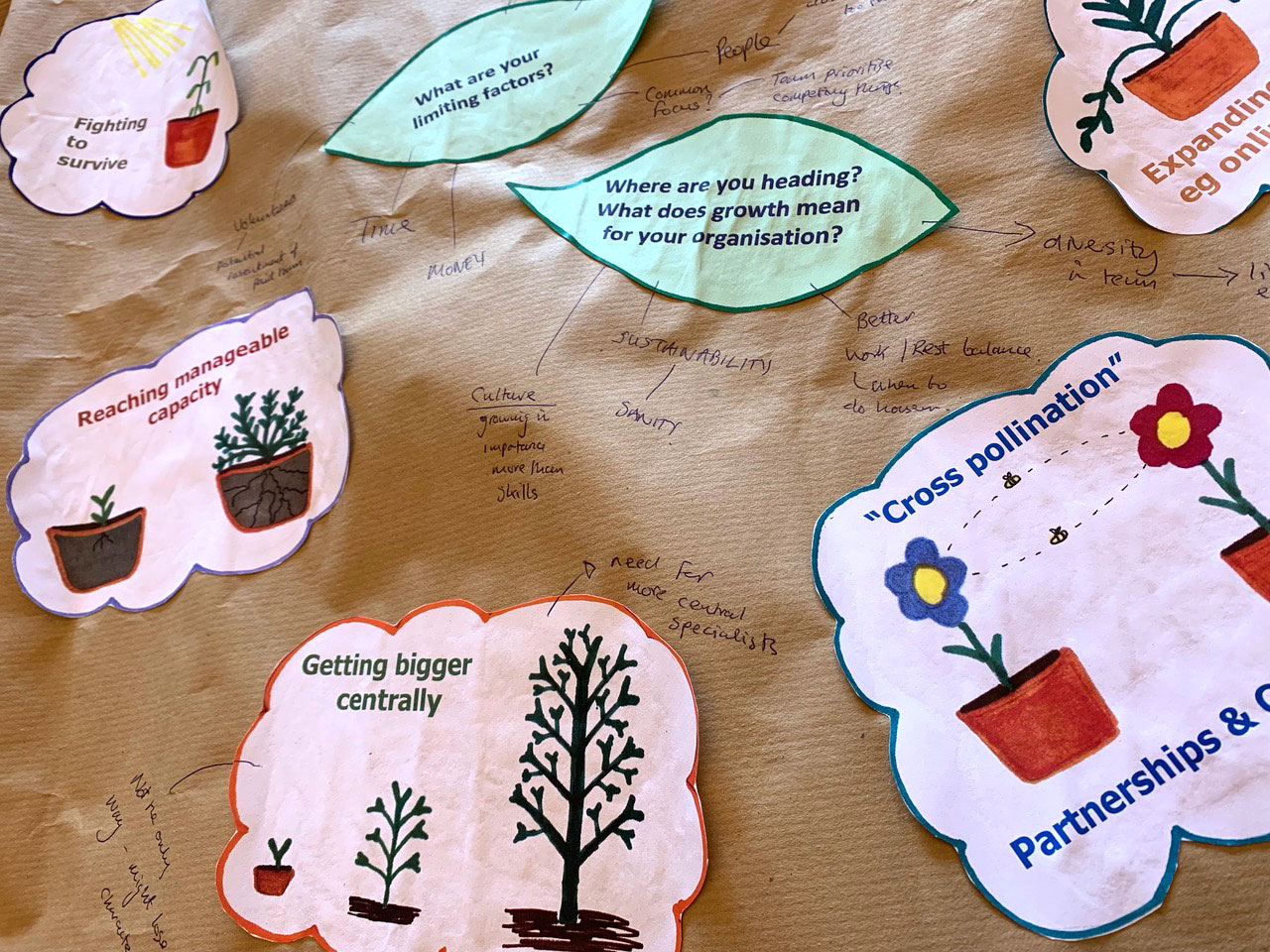
Know what is driving your growth: There are all sorts of reasons – a desire to reach more people, the need to recruit to avoid burnout, gaining funding for specific work and many others. Knowing what the key drivers are can help us to look at the different models of growing.
Growth isn't always about getting bigger: it may be about releasing or licensing resources or building partnerships with other organisations.
Know your core purpose and keep checking in on it: Whether we are growing or regrouping, we need to check that we are still bringing the positive change that we work for.
"Seeds need seasons": We found a richness in looking at the seasons – a time for planting, for nurturing and tending the crop, for harvesting, pruning and for resting the soil. There are plenty of lessons in that cycle for us to apply to our organisations but in particular, many of us recognised a need as leaders and as teams to celebrate the work that we have achieved and to reflect and replenish before starting new activities or programmes.

 As you'll see below, we've been involved in lots of conversations about measuring social impact. The most important reason for doing this is so that organisations can see whether they are actually making the difference that they want to make for their beneficiaries, and whether there is anything that they could change to improve that.
At Imagine Foundation we support small charities and community groups with funding, but we also want to empower the project leaders and invest in them by sharing learning and good practice across the organisations. We want our project partners to have the best impact that they can on their beneficiaries, so we need to ask what our impact is on our partners – through our decisions and interactions. Recently we asked the Transformational Index team to carry out an Impact Analysis on IF. You can read the full report here.
We were encouraged by the report and are now working on some key areas – finding ways to advocate on behalf of small charities, and building an online forum for sharing learning across our project partners.
 You may notice that a lot of our conversations are about ways to measure the social impact that we and our partner projects have. That's because there is a big conversation about this in the charitable sector right now. A number of groups are working in partnership to develop this conversation and to share learning and offer advice and help for organisations of all sizes to engage with. They are working together as Inspiring Impact, and Imagine Foundation has joined them as an Impact Champion. The Inspiring Impact website has publications to help you develop your impact measurement, the Impact Hub, a directory of resources and tools, and Measuring Up! a self-assessment tool to help you get started or move further forward.
Telling the story of our impact is really exciting - after all, it is about the real difference that we are making. It's great that so much help is available to help us get better at measuring what that difference is and enabling us to put our resources where they are most needed to help others.

The primary, and most important benefit of measuring your impact is that it helps you get better at making a difference, by seeing clearly what works well and what doesn’t.

If you can demonstrate the difference that you are making– what difference might it make to your stakeholders? (Volunteers, donors, beneficiaries, funders, staff etc)
Make a list of your stakeholders and imagine you had a dial next to each one. If you could turn the dial up on the one group of stakeholders that would have the biggest impact on your project which would it be? What could you do turn the dial up?

Over recent years there has been a massive shift in the structuring and resourcing of social purpose organisations, with many more options and crossovers between business, charity and government provision. As a result, the way charities are funded is changing and will change. There is a need to diversify where your resources are coming from and think outside the box – because the box is changing!
Who values your impact? Are there businesses or organisations that benefit from the difference you make within your community? Are there ways that you can build a partnership with those that benefit from your impact or value what you do?
(Thanks to Lindsay Noble for illustrating our conversations).